Learning to Take Visual Notes in the Age of Digital Overload
by Lucia Tringali
Thinking with your hands is the title of the graphic‑facilitation and visual‑tools activity we designed for the Erasmus Adult Education world, and that we offer at Casa Gavoglio to international groups visiting Genoa.
What does it mean to think with your hands?
It means that when we sit in front of a screen and passively consume content, our brain is not working at its full potential. But when we switch off the phone, close the laptop, and gather around a table with paper, pens, and materials—alone or with others—something shifts. We unlock a different mode of thinking. Ideas become alive and visible.
Thinking with your hands begins with letting go of the belief that you cannot draw. A conviction we encounter in most adults. The first question we ask in the course is always: “Can you draw? Yes or no?” followed by: “Why do you think so?”. Very few answer yes—usually those who studied art, architecture, or were encouraged by someone. Most adults are convinced they cannot draw. The reason is simple: they stopped.
Children in preschool are constantly given colours; the classic way to keep a bored child busy is “take a sheet and draw”. But around age 7, 8, or 9, something happens. Spontaneous drawing is no longer enough. Children begin to notice the gap between what they see and what they can reproduce, and often abandon drawing because they cannot copy reality. “I can’t do it, I’m not good enough.” Unless, in that moment, someone—like the “aunt with markers”, as my 9‑year‑old nephew calls me—says: “Don’t be silly! It’s not about being good, let’s do it together!”, that child will inevitably stop drawing. Convinced they lack talent.
I often use a sports metaphor: it’s as if we threw children into a pool and, once they learned to float and blow bubbles, told them: “Great, now swim butterfly or compete in a speed race.” As if technique didn’t exist in drawing.
And then there’s the myth of talent. Many say “I’m not an artist”, forgetting that art is mostly technique, sweat, effort, and commitment. In our course, the first thing we do is take a pencil and make a blind scribble, then pass it to the person next to us and see what they find in it. Everyone can do this. Once the pencil touches the paper again, the important thing is to continue in a way that immediately gives you the feeling that you can do it.
We start from the basic shapes of graphic facilitation—circles, squares, lines, and dots—and use them to draw icons. When the hands move before the mind, the mind unlocks and quiets that “inner critic”, that annoying little figure perched on the adult’s shoulder whispering: “Stop it, you can’t draw.”
We like borrowing a phrase from Gianni Rodari’s Grammar of Fantasy: “Tutti gli usi della parola a tutti. Non perché tutti siano artisti, ma perché nessuno sia schiavo.” We adapt it: All uses of drawing to everyone. Taking away someone’s possibility to draw means depriving them of a piece of creativity—and of reasoning. Because drawing is thinking. It helps us understand reality.
In the classroom we also use building bricks and recycled materials, asking participants to answer a question using their hands, working in silence. It is a deeply inclusive approach: those who struggle with words, those who are shy, or unused to group settings can move their hands freely. And those hands bring out meanings and stories far deeper than a simple round‑table discussion.
Graphic facilitation was born in the corporate world to bring lateral thinking into business models. We like bringing it into adult education. Thinking with your hands helps educators and practitioners look at the world differently, seeking detail, beauty, and wonder beyond routine.
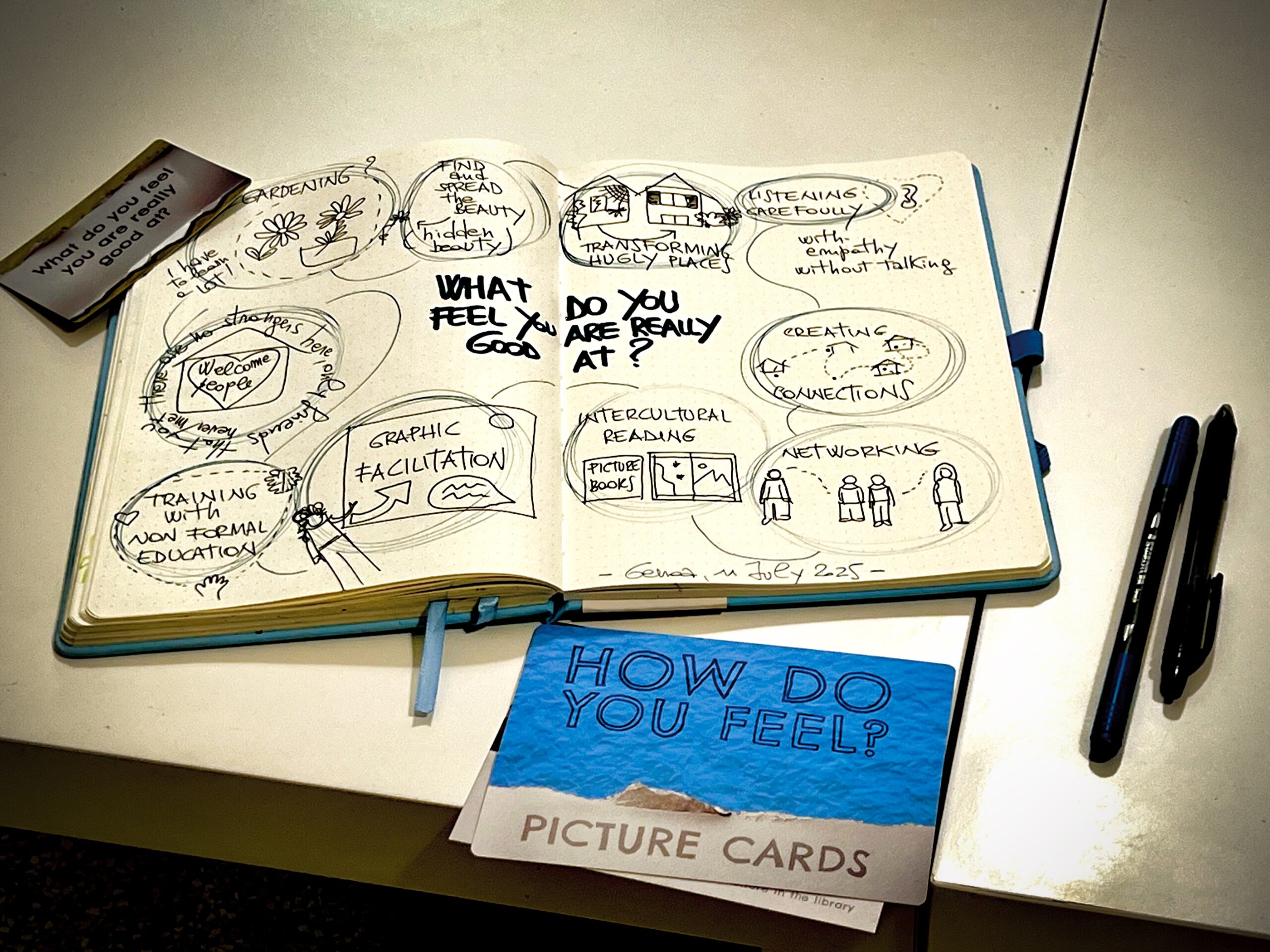
Taking notes for oneself by combining words, icons, and colours is not just an artistic gesture—though it can become one, if you get used to walking around the city with a notebook and pen, sketching what you see and noting sensations, smells, encounters. It becomes visual synthesis when used intentionally to summarise a topic.
Try this: watch two or three short videos showing a recipe or a creative activity. A few hours later, do you remember what you watched? Today we are immersed in a constant flow of digital content, videos, and reels from which it is extremely difficult to retain anything. Taking the time to watch a video and then—rather than moving on to the next—opening a notebook and jotting down a few visual notes is excellent training for the brain. It helps us study better and counteracts screen dependency, engaging the hands instead of just the thumb scrolling on glass. It’s a great antidote to doomscrolling, and a smart way to use digital tools consciously. Less, and with a pencil in hand.
Graphic facilitation also means welcoming a group and accompanying their learning process through a series of caring gestures that communicate: I care. From the welcome poster to the hand‑drawn agenda, including a simple (almost banal) action: every task for the group is not only explained verbally but written down, with clear lettering visible to all.
A visual approach is essential when working with adults who have vulnerabilities or do not master the language: having a task written and drawn on paper, instead of only spoken, is not “another way of doing things”. It is another way of thinking about that group, of teaching, of facilitating processes.
Today artificial intelligence can create infographics in seconds from text, audio, or video. The question is legitimate: what is the point of a graphic facilitator if a machine can do the same? The person who listens with a marker in hand during a meeting, who looks you in the eyes and captures on a blank sheet what the group is saying, is not performing a mechanical action. It is a gesture of deep care. It means: “I am listening to you, I am interested in what you say, I see you, and everyone can see your contribution.”
A group discussing an idea while pointing at images on a table. A person who, thanks to a photo, tells you how they feel—even when words are not there. No machine will ever replace this. Welcoming a group with a hand‑drawn “welcome” poster or a visual agenda means saying: “I care about you, I dedicated time to create this for you.”
The joy of someone who, on the first day of the experience, had answered “no” to the question “Can you draw?”, and who spent an entire week trying, doodling, making mistakes, and enjoying the process; and who, on the final day, tells us: “I have a new language, a new way of thinking” is one of the things that gives meaning to our work..
Who wants to try?
Related Posts
PENSARE CON LE MANI
 “Ma perché hanno costruito lì?”