
I know of nothing in the world that has as much power as a word. Sometimes I write one, and look at it, until it begins to shine.
Emily Dickinson
“How do you feel?”
Think about the last time you were asked this question. If you’re fine, no problem, but… what if something is wrong? Can you understand and explain what you are feeling? Do you know how to get help?
Often the person asking this question is a psychotherapist or psychiatrist, but not everyone turns to mental health services when they need them. It could be because of cost, fear, stigma, or because they do not know how to contact them. Or, also, because of a lack of awareness about their symptoms and their own discomfort.
In Italy, it is possible to access mental health services offered by the National Health Service, through a request from one’s family doctor. The service is almost free: you only have to pay a small fee (called “ticket“). Unfortunately, however, the places available are not sufficient to cover all the needs of those who need them.
The topic of mental health, in our context, often remains confined to narrow areas: it is rarely part of the programming of cultural venues, such as museums and libraries, or of people’s daily lives.
Many times we have found ourselves explaining how access to public mental health services works to people we know or to families who frequent the neighbourhood house and library. None of them knew how to access care, or that it is possible to get better by getting help from professionals.
In taking up the challenge launched by the European Cultural Foundation, we decided to work on this topic, to try to break it out of its stigma. “Me at the psychologist? I’m not crazy!”: how many times have you heard this phrase? Well, then you certainly know what we are talking about.

How did we work?
We started with the question that is the title of the project: How do you feel?
An important question that, all caught up in the hustle and bustle of everyday life, we often forget to ask ourselves.
What if libraries started asking this question?
What if the people who frequent our space found it written in the rooms, or in the garden, together with a cup of coffee? To realise the project we involved the team of professionals from the Mental Health Centre of Genoa: social workers, rehabilitation therapists, educators, psychologists. Together with them we built a regular appointment called ‘A coffee in the library’.
Imagine a person going out for a walk with the dog, or taking the children to play in the park, and in front of the library he finds a small table, a steaming teapot, chocolate biscuits and a sign with the question: ‘How do you feel?’ There she has the opportunity to approach and ask about access to mental health services.
‘Will it work? Will someone come?’
It was a gamble. Who could have any interest in approaching?
Don’t imagine large crowds: the turnout was one or two people per meeting. But for us (who weren’t expecting any) it was a lot. Because every person who came felt that invitation to stop and have a coffee as a safe, warm and welcoming space.
And so, thanks to that coffee in the garden, in a cosy and informal atmosphere, it was possible to go from the generic ‘how are you?’ to ‘you know that if you need it here you can ask for information?’. Alongside us were mental health service workers, giving information on access to services.
It was also a way to bring the topic of mental health out of the medical sphere, to make it an ‘inhabitant’ of a public, informal space in a neighbourhood with a thousand economic and social fragilities. Where taking care of oneself, amidst a thousand problems of money and health, is almost never a priority.
On this very important issue, we felt it was important to also leave a concrete trace: a toolbox that all The Europe Challenge project libraries could download, use, translate into many languages.
Are stories good for you?
We liked the idea of working in libraries starting with a question: ‘Are stories good for you?’ Librarians and passionate readers answer without a second thought: of course they do! Research on the relationship between reading stories and psychological well-being is plentiful and proves it.
Our aim was to create a tool for facilitating groups, which could be used in a thousand ways, even those not envisaged by us. At the centre of the work is a particular type of book that has a lot to say: silent books, the illustrated books in which the narration consists only of illustrations, without the need for text.
It is a tool that we love very much: our library is full of stories without words, with which we work with migrant children, teachers and educators, and children/young people from many countries around the world.
We asked a group of people who work with libraries (educators, teachers, volunteers, librarians) to work with us and the Mental Health Centre team to build a toolbox dedicated to the relationship between stories and personal well-being/mental health.
The workshop
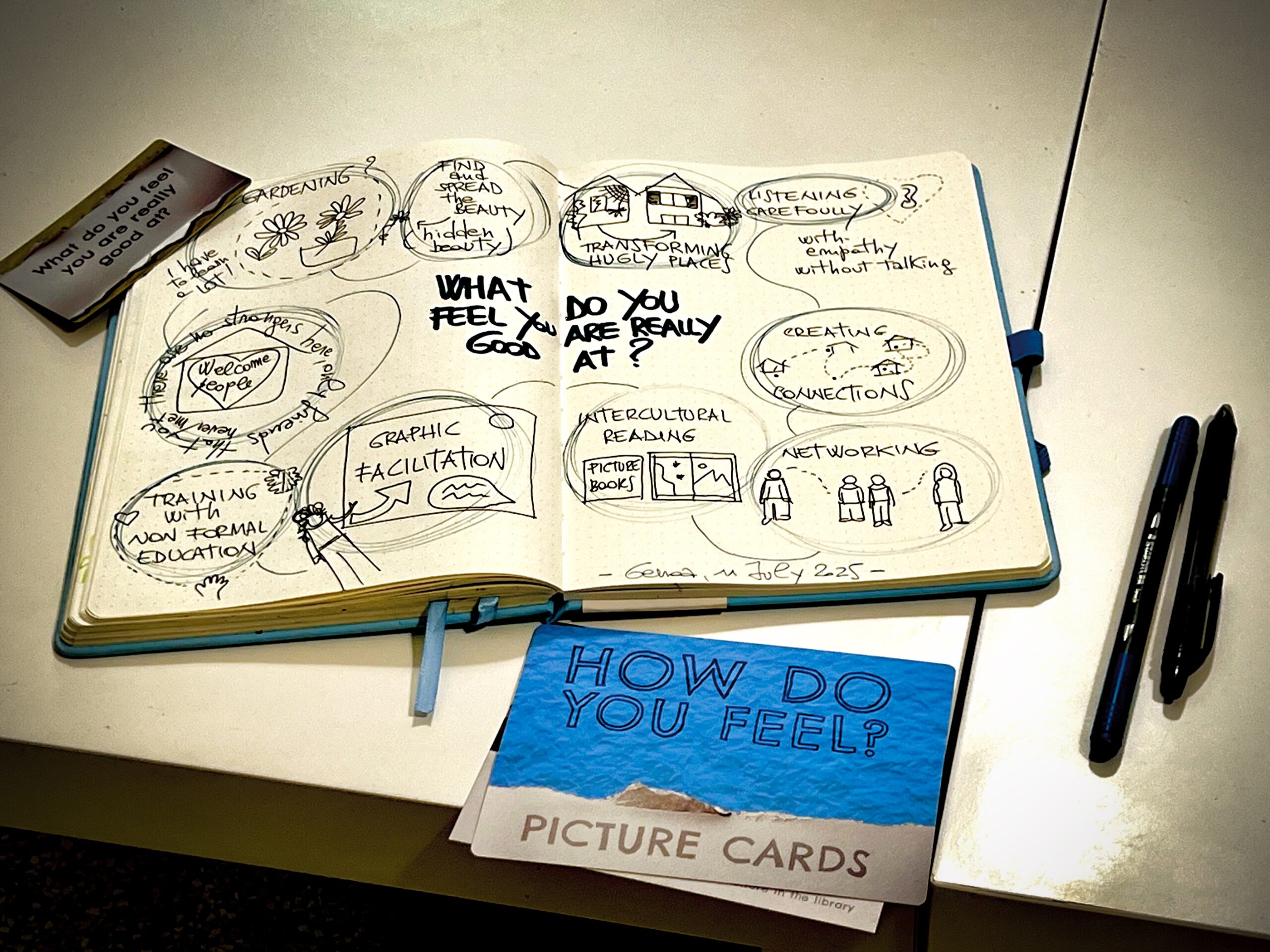
Keeping us company all along the way was the question that gives the project its title: ‘How do you feel?’. To answer this question verbally is not easy. We are not used to thinking about it. We often don’t have the words to answer it. With the group we looked for images, illustrations, stories that could help people carve out a time and space to think, and to try to answer.
We liked the idea of creating a tool that would work exactly like a DIY toolbox: depending on what you want to do that day, you open the box and use a tool.
During the 6 workshops of the project we went in depth, asking the people who worked with us to look for words and stories to answer the questions we were asking.
The first was suggested by the participants: ‘What do you need to feel good?’
We tried to answer with single words, to which we linked poems, novels, picture books, in a potentially endless game of searching for meanings and the possibility of getting lost among the shelves of a library, looking for answers, or other questions.
And then, again, we used books (in particular silent books, illustrated books without words) to generate other questions that could help people open many small doors thanks to books: to reflect alone; to dialogue with others; to write or draw something. To talk about wellbeing and mental health in a welcoming and safe space, each according to their own possibilities.
The result is a kit of seven decks of cards, which can be used in many ways. It contains words, questions, pictures and images.
The Toolkit
We like to imagine librarians opening the box to facilitate a reading group. Or leaving it available for people to browse through freely.
An educator, a mental health service worker can use the box to break the ice, to start a conversation with a person or a group.
A teacher can pose questions to his or her students, to get to know them better and work with the class on social-emotional well-being.
A library reader can draw a card (word, picture or question) and answer it in a personal way, even on their own.
The items in the box can be used as inspiration for an artistic activity, such as a visual diary, mood board, photo and video narration. And, if and when you are ready, share something with others.
The “How do you feel?” toolkit can be freely downloaded and used: it is published under a Creative Commons – BY – NC licence, so all you have to do is cite the source and commercialisation is prohibited.
What’s inside the box?
What does it contain? Each kit consists of 7 decks of cards:
- n°1 deck Picture Cards (60 cards + 1 deck of instructions)
- n°1 deck Emotion Cards (53 cards + 1 set of instructions)
- n°1 deck Emotions Cards (15 cards + 1 set of instructions)
- n° 1 deck Word Cards (45 cards + 1 set of instructions)
- n°3 decks Question Cards:
- Icebrakers (35 cards + 1 set of instructions)
- Self-reflection (36 cards + 1 set of instructions)
- Psychological well-being (61 cards + 1 set of instructions)
Instructions
If you are curious about how we worked, here you can find a printable PDF file with the creation process, deck composition and simple tips for usage.
Download your toolkit for free
You’re almost there! To download the printable file of “How do you feel?” toolkit, click on the blue button and fill in the tiny little form!
Related Posts
 THINKING WITH YOUR HANDS
PENSARE CON LE MANI
THINKING WITH YOUR HANDS
PENSARE CON LE MANI
 “Ma perché hanno costruito lì?”